
Treating A Broken Tooth
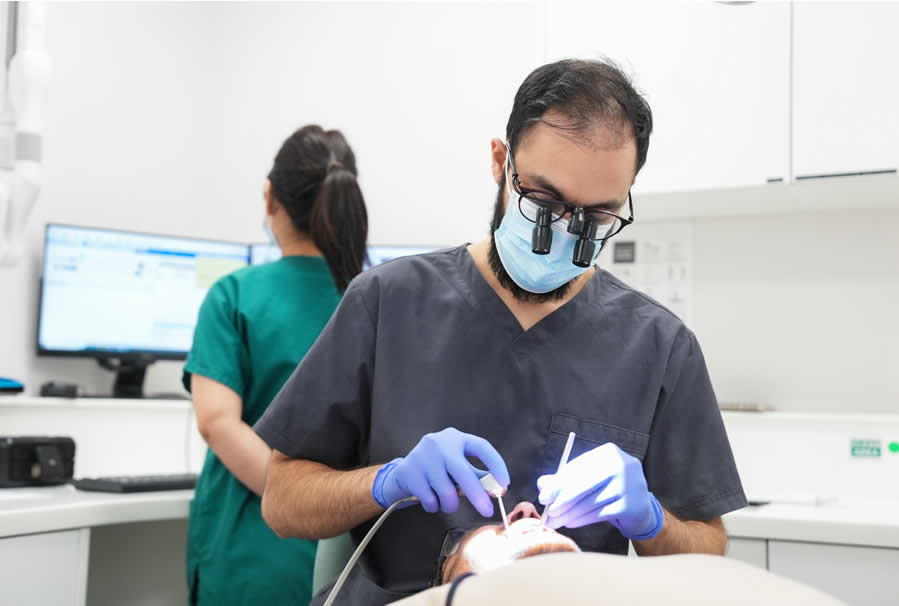
What are your treatment options in Acton when your tooth breaks?
A tooth can break due to decay and general neglect over a period of time, but they can also break for a number of more immediate reasons too. Sometimes it might be a fall or an accident, but it can just as easily happen while you’re eating your lunch, especially if a tooth is already weak.
The damage could be relatively minor such as a chipped corner of the tooth, or you may discover that quite a sizeable piece has broken away. It can be concerning when this happens, especially if the tooth starts to hurt, but try not to assume the worst. A broken tooth can often be repaired, although the most suitable treatment will depend on what has been damaged.
Why do teeth break?
Teeth are strong, but they do have their limits. Biting down on a hard sweet, an olive stone or an unexpectedly tough piece of food can sometimes cause a break. Sports injuries and falls are other common causes. The tooth may have also been vulnerable in the first place. A tooth with a large filling has less natural structure left to support it, while decay can weaken the remaining tooth without being obvious from the outside. Grinding your teeth, particularly over a long period of time, can put them under considerable strain too. Whatever the cause, it is important to arrange an appointment at the Acton Vale Dental Centre even if the damage seems relatively minor to you. A chip that doesn’t hurt may be straightforward to repair, but a crack can sometimes extend further into the tooth than you might expect.
Will this mean major treatment?
This will depend on the nature of the damage. If it is only a small chip that has come away from the tooth, the dentist may simply smooth the rough edge. Where a little more has broken away, a tooth-coloured composite material can sometimes be used to rebuild the missing part. This is particularly useful for front teeth, where even a small change can be noticeable when you smile. The advantage of a simple repair is that it can preserve most of the natural tooth. There isn’t much point in removing healthy tooth structure unnecessarily if a smaller treatment will do the job. A larger break is a different matter. If the tooth has lost a substantial amount of its structure, a filling may not provide enough support. In that situation, a crown might be recommended to cover and protect what’s left.
The breakage doesn’t hurt
This might sometimes be the case, but a lack of pain shouldn’t be taken as reassurance that nothing serious has happened. The outer enamel protects the more sensitive layers beneath it. If a break reaches the dentine (the layer beneath the tooth enamel), the tooth may well become sensitive to cold drinks, hot food or any applied pressure when chewing food. If the damage reaches the pulp area of the tooth, this is likely to require a more complex treatment known as a root canal procedure.
In some cases, the pulp might remain healthy despite the breakage. In other cases, it may become irreversibly inflamed or infected. If that happens and the tooth can still be saved, root canal treatment may be needed. This involves removing the damaged pulp, cleaning the canals inside the roots and sealing them before the tooth is restored. A crown may then be needed to help protect the weakened tooth, although our Acton dentist will decide on the most suitable restoration following assessment of the damage.
Extractions
In some cases, a badly damaged tooth may not be able to be saved, or if it were to be, the prognosis may be very poor. In these cases, an extraction would be the only other option available. Naturally, this will leave you with a gap in your teeth and you may wish to look at the options to close it. These include the use of dentures, a bridge or dental implants, an increasingly popular tooth replacement treatment.
Immediate care when a tooth breaks
If a tooth breaks suddenly, you should avoid chewing with it until it has been assessed. If you find the broken piece, please keep it and take it to the appointment; occasionally, it may be useful to help us assess the damage. Do not avoid putting off treatment just because the tooth isn’t hurting. If the break follows an accident, or you have severe pain, swelling or bleeding that won’t stop, seek urgent dental advice. Difficulty breathing or swallowing requires emergency care and you should call for prompt assistance.
Most tooth breakages can be resolved in a straightforward way, while some may require more complex dental treatment. Once a tooth has broken though, if left, problems are much more likely to become worse. Even if there is no pain you should always have the tooth checked so that any treatment can be carried out as soon as possible.
If you need to see a dentist for a broken tooth or any other oral care issue, please call the Acton Vale Dental Centre for an appointment on 0204 5276 982.